This post shows how late I am. Spring is starting, and I’m only now showing Mari’s osechi ryori, or New Year’s cooking, at her family’s place in Saitama. Served in a three-tiered lacquer box, as is custom.

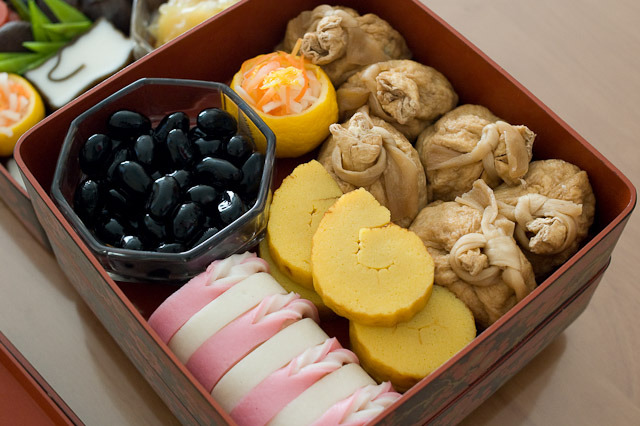

This post shows how late I am. Spring is starting, and I’m only now showing Mari’s osechi ryori, or New Year’s cooking, at her family’s place in Saitama. Served in a three-tiered lacquer box, as is custom.
Comments
6 responses to “New Year’s Food”
I see maybe two things in there that I recognize, but the whole thing is very aesthetically pleasing. It must have taken a lot of work.
im really impressed of your work. the photos are quite interesting and they look even professional. Are you a professional photographer? i come from germany and i have also relations to philippines….
Tave, a couple of those things were ready-made, but the rest did take a lot of work (by Mari). After being here for a few years over the holiday season, I miss exotic things from back home like turkey and cranberry sauce.
Vanessa, thanks! I’m not a professional photographer, but I’m flattered you think I could be. (I design websites for a living.)
I haven’t picked up my camera in awhile… : (
Have you had a chance to visit the Philippines?
yes ive been there although its a long travel from here to the philippines. but i like that country very much. i think its good for taking some good pictures, because i want to study photography. so i want to visit it as soon as possible. hope you have fun by doing your work. i like it.
That bento box is so beautiful! Do you remember what the soba colored twists are in the bottom right of the last photo?
Ah, the twisty things are made from slices of konnyaku, a firm jelly made from flour from the konjac (also known as “devil’s tongue”) root, which is similar to taro. You can buy bricks of the brown-grey speckled jelly in water-filled plastic packs. Konnyaku has little flavor, but the firm gelatinous texture gives it a satisfying chewiness. It sometimes has a slight ammonia smell until it’s rinsed and boiled or fried. You’ll usually find chunks of it in oden, and it also comes in noodle form. They say konnyaku is a good diet food because it’s bulky and high in fiber but very low in calories.
You make the twisty shape, used for special occasions, by making a vertical slit in the middle of a long rectangle of konnyaku, then tucking one end into and through that slit.